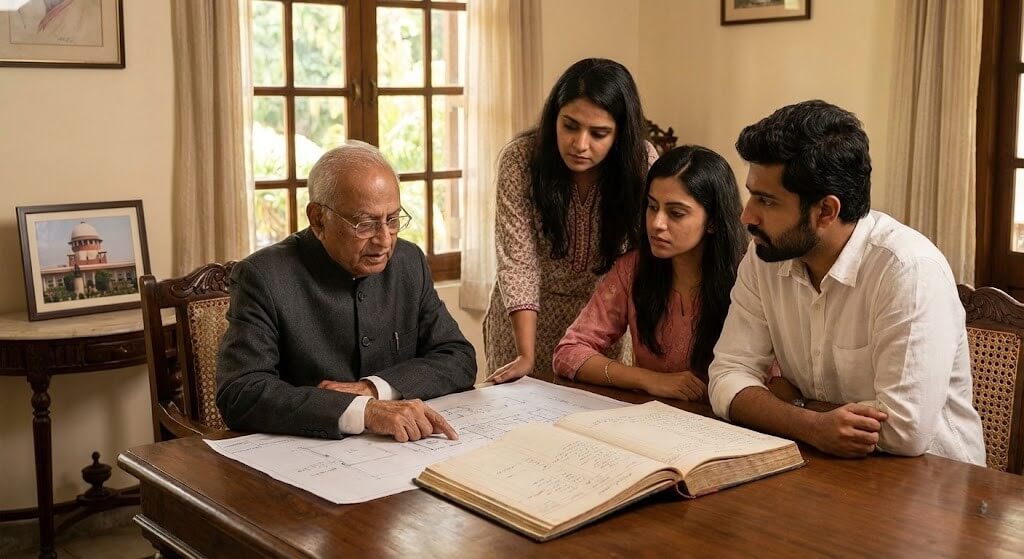
While not legally mandatory, making of a Will is important for ensuring the smooth transfer of assets and avoiding disputes among legal heirs.
Some of the benefits are as follow:
Legal Clarity & Avoidance of Disputes
A Will provides a legally recognized declaration of a person’s final wishes regarding the distribution of their property.
In the absence of a Will, assets are distributed as per intestate succession laws as applicable. (Hindu Succession Act, 1956 for Hindus, Indian Succession Act, 1925 or Personal Law for others), which may not align with the deceased’s wishes.
It helps prevent conflicts and legal battles among heirs.
2. Freedom to Distribute Assets
A person can distribute his assets as per his own wishes.
One can include non-legal heirs, such as friends, charities, or distant relatives.
3. Protection of Vulnerable Dependents
A Will ensures financial security for dependent family members, such as minors, elderly parents, or disabled relatives.
Guardianship for minor children can be specified.
4. Avoidance of Legal Complications & Delays
Without a Will, heirs may have to go through a long and expensive legal process to claim their rights.
A Will simplifies the inheritance process.
5. Special Bequests & Wishes
A Will allows a person to specify personal or sentimental bequests, such as jewellery, or property, ensuring they go to the intended beneficiaries.
It can also outline funeral wishes or set up trusts for specific purposes.
CONTENTS OF A WILL
To make a valid Will in India, certain legal requirements are to be complied with to ensure the Will is enforceable after the person’s death. These are outlined under the Indian Succession Act, 1925 (Part VI), which deals with testamentary succession specifically the Wills made by for most communities including Hindus, Buddhist, Sikh & Jaina. Wills made by Muslims governed by personal laws.
A Will is a formal document that outlines how a person wants their assets distributed after their death. A well-drafted Will should be clear, precise, and legally valid. Following are the key contents of a Will.
1. Title and Declaration
• Clearly state the document is a “Last Will and Testament”.
• Include a declaration like:
“This is the last Will and Testament made by me, [Full Name], son/daughter of [Father’s Name], resident of [Full Address].”
2. Personal Details of the Testator
• Full name
• Age
• Address
• Religion (important for applicable laws)
• A declaration that the testator is of sound mind and making the Will voluntarily.
3. Revocation of Previous Wills
• A clause revoking all earlier Wills, such as:
“I hereby revoke all previous Wills and codicils made by me.”
4. Appointment of Executor
• The executor is the person responsible for carrying out the instructions in the Will.
“I appoint [Executor’s Name], residing at [Address], as the executor of this Will.”
(Optional: You may also appoint a backup executor.)
5. Details of Beneficiaries
• Full names, relationships, and addresses of all people or organizations who will receive the property.
6. Statement of Assets
• List all major assets owned by the testator, such as:
• Immovable property (house, land, flat)
• Bank accounts
• Investments (shares, bonds, mutual funds)
• Jewellery
• Vehicles
• Other personal or movable property
7. Bequests / Distribution of Assets
• Clearly mention which asset is going to which beneficiary.
“I bequeath my house located at [Address] to my son, [Name].”
• Mention alternate beneficiaries, in case a beneficiary predeceases the testator.
8. Residual Clause
• Covers assets not specifically mentioned:
“All the remaining assets not specifically mentioned in this Will shall go to [Name].”
9. Guardianship (If Minor Children Are Involved)
• Appoint a guardian to care for minor children if both parents are deceased.
10. Attestation Clause
• A statement that the Will was signed by the testator in the presence of witnesses:
“This Will was signed by me in the presence of the undersigned witnesses, who also signed in my presence.”
11. Signature
• The testator should sign at the end of the document with date and place.
12. Witnesses’ Signatures
• At least two witnesses must sign the Will.
• Include their names, addresses, and signatures.
• They must not be beneficiaries.
STEP-BY-STEP GUIDE TO DRAFTING A WILL
1. Title & Declaration
• Start with the title: “LAST WILL AND TESTAMENT”
• Declare that you are making this Will voluntarily, in sound mind, and without coercion.
• Mention your full name, age, address, and date of writing the Will.
2. Revocation of Previous Wills
• If you have made any previous Wills, clearly state that this Will supersedes all earlier ones.
3. Details of Assets
List all your assets, including:
• Immovable property – Land, house, apartment, etc.
• Movable property – Bank balances, jewellery, vehicles, shares, etc.
• Digital assets – Online accounts, cryptocurrencies, intellectual property, etc.
4. Details of Beneficiaries
• Clearly mention the names, addresses, and relationships of the persons who will inherit your assets.
• Specify the share of each beneficiary.
5. Appointment of Executor (Optional but Recommended)
• Name an executor (a trusted person) to ensure that your Will is executed properly after your death.
• Mention their name, age, and address.
6. Appointment of Guardian
(If Minor Children Are Involved)
• Appoint a guardian to care for minor children if both parents are deceased.
7. Signature of the Testator
• Sign at the end of the Will to confirm that it represents your final wishes.
8. Attestation by Two Witnesses
• Two witnesses must sign the Will and mention their full name, age, and address.
• Witnesses should not be beneficiaries or their spouses to avoid legal complications.
9. Registration of Will (Optional but Recommended)
• Though not mandatory, registering your Will with the sub-registrar adds legal credibility.
Recent Articles
- Renewable Energy Laws in India: Regulatory Framework, Key Legal Issues and Emerging Opportunities 21-08-2026
- Legal Position of Karta 16-08-2026
- Reasonable Accommodation under the Rights of Persons with Disabilities Act, 2016 16-08-2026
- MEANING OF SUIT 15-08-2026
- LEGAL RECOGNITION TO ELECTRONIC RECORDS & DIGITAL STAMPING IN THE STATE OF RAJASTHAN 15-08-2026
- A GUIDE TO RECOVERY OF BANK’S DUES UNDER RODA-PART- 4 15-08-2026
- A GUIDE TO RECOVERY OF BANK’S DUES UNDER RODA-PART-3 15-08-2026