Why Karta?
The affairs of a joint family cannot be managed by all the members of it, nor are they managed jointly by all the adult male members probably by reason of the inequality in their rank; but ordinarily they are, by consent of all managed by a single male member, who is the head of the family by reason of his seniority and superior rank and is called manager or Karta of the family.
The Karta of the joint Hindu family is certainly the manager of the family property but undoubtedly possesses powers which the ordinary manager does not possess. The Karta cannot therefore be just equated with the manager of property. (Union of India Vs Shree Ram Bohra and Ors AIR 1965 SC 1531)
Karta Definition
The head of HUF is called Karta.
In paragraph 236 of Mulla’s Hindu Law, XII Edition, it is stated:
“Property belonging to a joint family is ordinarily managed by the father or other senior member for the time being of the family. The manager of a joint family is called Karta.
The father is in all cases naturally, and in the case of minor sons necessarily, the manager of the joint family property.” (As referred in AIR 1965 SC 1531)
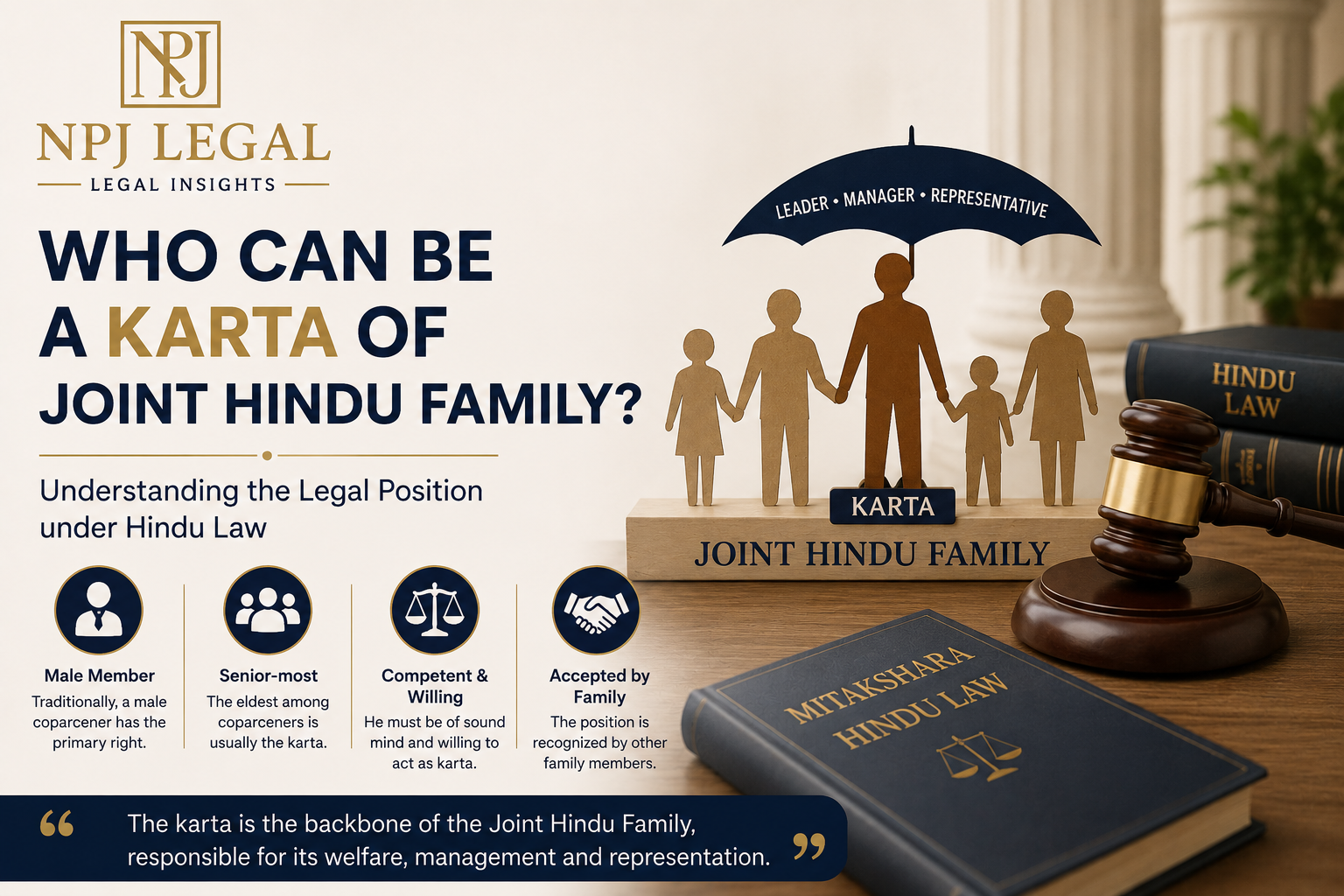
WHO CAN BE A KARTA
Father
The father if living would generally be the manager of the joint family property. As mentioned above as per Mulla’s Hindu Law, the father is in all cases naturally, and in case of minor sons necessarily, the manager of the joint family property.
Senior Male member
Where father is not alive and the family consists of brothers, the elder brother, in the absence of any evidence to the contrary should be presumed to be the manager of the family.
So long as the members of the family remain undivided, the senior member of the family is entitled to manage the property, “including even charitable properties” and is presumed to be the manager until the contrary is shown. (Paragraph 234 of Mulla’s Hindu Law, XXIII Edition, 2018).
Junior Male
“The senior member may give up his right of management, and a junior member may be appointed manager. Similarly, a junior member can act as Karta if the senior member has relinquished his right expressly or impliedly or in the absence of the manager under exceptional circumstances. (Paragraph 234 of Mulla’s Hindu Law, XXIII Edition, 2018).
As long as a senior member is present, a junior member cannot become unless all the coparcener agrees to the junior member occupying managerial position as affirmed in the Narendrakumar J. Modi Vs. CIT (AIR 1976 SC 1953)
In Piarey Lal & Anr. vs. Mahadeo Prasad & Anr. (MANU/OU/0089/1942: AIR 1942 Oudh 311), it has been laid down that when family carries on several businesses and junior member manages one of such businesses then his acts bind the whole family and Karta. This situation develops because karta cannot manage personally all the businesses and he entrust the business to junior member, who conducts it as Manager on behalf of Karta. Therefore, if Karta expressly or impliedly authorises the junior member to manage the business, the junior member on the basis of that express or implied authority carries on the business and on this principle, he binds by his acts all the members of the family including Karta.
In another case – Adapa Venkatachalam & Ors. vs. Vemalepathi Venkateswara Rao & Ors. (MANU/TN/0207/1943 : AIR 1944 Mad. 33), the junior member was in charge of the family business and he had the implied authority of all other members to act and enter into transactions relating to the business, therefore, part payment made by him to save the debt contracted for the business of the firm would bind the other members.
A similar view has been taken in K.M. Ramakrishna Mudaliar Vs. V.S.V. Manikka Mudaliar & Ors. (MANU/TN/0224/1936 : AIR 1937 Mad. 375) that a junior member conducting family business can mortgage or sell joint family property for debts and liabilities incurred in the course of that business. It is further held that even a junior member in charge of the family business will have all the rights and powers which are necessary for the proper conduct of the business exercised by a managing member.
If has been enunciated in Tribhovandas Haribhai Tamboli vs. Gujrat Revenue Tribunal & Ors. (MANU/SC/0355/1991 : AIR 1991 SC 1538) in para 12 that the senior member of the family is entitled to manage the family properties provided he is not incapacitated by illness or other sufficient cause, if the father resigns or in his absence the management devolves upon the eldest male member of the family. Thus, the right to manage joint family property is created by birth and regulated by seniority. A junior member can deal with the joint family property only where Karta relinquishes his right expressly or impliedly or in the absence of the Karta in exceptional or in extraordinary circumstances
In Chunnilal vs. Kalu & Ors. (MANU/RH/0053/1966 : AIR 1966 Raj. 208):
“The principle of Hindu Law is that the Karta is entitled to take all steps for the preservation of the family and if it is necessary to carry on joint family business for the preservation of the family, the Karta can take all necessary steps to carry it efficiently. Sometimes a business cannot be managed by the Karta personally and other members of the family participate and manage the business with the express of implied consent of the Karta. That such participation and management is with the consent of the Karta may be inferred from the facts and circumstances of a case.”
It was further held:
“If in the management of a joint Hindu family business there may be more than one manager the act of each of them are binding on the joint family.”
The learned Judge also observed:
“In my humble opinion, the aforesaid observations do not in any way modify the ancient rule of Hindu Law that junior members of the joint family are only bound by the acts of the manager and not of other members. It only extends the principle ingrained in that law that the manager has the authority to take all necessary steps for the sake of preservation of family. He may permit if necessary the junior members of the family to participate and manage the business and all the members of the joint Hindu family are bound by the acts of such junior members. Such an extension of old rule of Hindu Law is within permissible limits, looking to the modern conditions of conducting the business. If Hindu Law is to survive, such an extension of the doctrine must meet the approval of courts of law, otherwise the strangers will find difficulty in conducting business with the joint Hindu family. Taking a rigid view of the matter will only hamper the development of Hindu Law in the modem conditions. Ancient sages while formulating the principles of Hindu Law never contemplated any rigidity in the matter.”
Minor:
A minor cannot be the manager of it JHF. Under Hindu law coparcener ship qualification for the membership of JHF. If any Hindu Undivided family is left in a position where there is only a minor left to become the Karta, he can do so under section 21 of the Guardians and Wards Act 18977, provided the minor has a guardian who is an adult, who represents and guides him in decision making, but this only works if no other members capable of being Karta are alive
Female as Karta
Before Hindu Succession (Amendment) Act 2005, it was held by many courts that only a coparcener could become ‘Karta’ of HUF. Thus, a female member was not allowed to become ‘Karta’ of HUF as she was not treated as ‘coparcener’. However, with effect from 06th September, 2005 i.e. post amendment, the position of a female member has changed significantly as female member has now been permitted coparcenary rights in HUF property. As such, now female member can become ‘Karta’ of HUF and such can act as manager of joint family properties in their full rights
Hon’ble Delhi High Court in a landmark verdict in case of Mrs Sujata Sharma vs Shri Manu Gupta held that the eldest female member of the family can be its ‘Karta’ in a HUF.
Following has been Hon’ble High Court
“…that the impediment which prevented a female member of a HUF from becoming its Karta was that she did not possess the necessary qualification of co-parcenership. Section 6 of the Hindu Succession Act is a socially beneficial legislation; it gives equal rights of inheritance to Hindu males and females. Its objective is to recognise the rights of female Hindus as co-parceners and to enhance their right to equality apropos succession. Therefore, Courts would be extremely vigilant apropos any endeavour to curtail or fetter the statutory guarantee of enhancement of their rights. Now that this disqualification has been removed by the 2005 Amendment, there is no reason why Hindu women should be denied the position of a Karta. If a male member of an HUF, by virtue of his being the first born eldest, can be a Karta, so can a female member. The Court finds no restriction in the law preventing the eldest female co-parcener of an HUF, from being its Karta. The plaintiff‟s father‟s right in the HUF did not dissipate but was inherited by her. Nor did her marriage alter the right to inherit the co-parcenary to which she succeeded after her father‟s demise in terms of Section 6. The said provision only emphasises the statutory rights of females…”
Position of Widow.
In Shreya Vidyarthi Vs Ashok Vidyarthi and Ors ( AIR 2016 SC 139), Hon’ble Supreme Court held as follows:
“While there can be no doubt that a Hindu Widow is not a coparcener in the HUF of her husband and, therefore, cannot act as Karta of the HUF after the death of her husband. Two expressions i.e. Karta and Manager may be understood to be not synonymous and the expression “Manager” may be understood as denoting a role distinct from that of the Karta. Hypothetically, we may take the case of HUF where the male adult coparcener has died and there is no male coparcener surviving or as in the facts of the present case, where the sole male coparcener is a minor. In such a situation obviously the HUF does not come to an end. The mother of the male coparcener can act as the legal guardian of the minor and also look after his role as the Karta in her capacity as his (minor’s) legal guardian”
Hon’ble Supreme Court is this case also observed that regrettably the position remain unaltered even after the amendment of Hindu Succession Act in 2005.
A widow therefore, cannot act as karta of the HUF after the death of HUF of her husband.
More than one Karta
Legal position of two kartas has been enunciated Hon’ble Supreme Court in Union of India vs. Shree Ram Bohra & Ors. (AIR 1965 SC 1531). In this case following has been held:
“We have not been referred to any text of Hindu Law or any decided case in support of the proposition that a joint Hindu family can have more than one Karta. The very idea of there being two Kartas of a joint Hindu family does not appear, prima facie, consistent with the concept of a Karta. Their describing themselves as Kartas of the joint Hindu family owning the firm and their suing as such cannot make them Kartas of the joint Hindu family if the Hindu Law does not contemplate the existence of two kartas.
The existence of two kartas cannot lead to the smooth management of the property of the joint Hindu family and the other affairs of the family in view of the powers which the karta of a joint Hindu family possesses under the Hindu Law, powers which are not restricted to only such powers which ordinarily the manager of property of certain persons who confer authority on him to manage the property possesses.
The fact any other member or members other than the manager of the joint Hindu family, carry on business etc., on behalf of the family, does not mean that such members who act for the family do so as kartas of the family.
In the absence of any text of Hindu law or of any previous decision that a joint Hindu family can have two kartas we are not prepared to express any definite opinion on the question whether there can be two kartas of a joint Hindu family and, if there can be two kartas, what would be the effect of the death of one of them on the maintainability of a suit brought by both of them.
Two persons may look after the affairs of a joint Hindu family on the basis of the members of the joint Hindu family clothing them with authority to represent the family. They would be two persons entitled to represent the family and their power to represent would depend on the terms of the authority conferred on them by the members of the joint Hindu family. Their authority to act for the family is not derived under any principle of Hindu law but is based on the members of the joint Hindu family conferring certain authority on them. It cannot, therefore, be said that when two such representatives of a joint Hindu family sue and obtain a decree in their favour for the benefit of the joint Hindu family, and an appeal is filed against both of them as respondents representing the joint Hindu family, the other representative would continue to represent the joint family on the death of one of the representatives. He could not possibly do so when the authority given by the joint Hindu family be to the effect that both of them were to act jointly. In the absence of any knowledge about the terms of authority of the two representatives, it is not possible to urge successfully that on the date of one of the representatives, the other representative still continued to represent the joint Hindu family. On the death of one of the representatives, the karta of the family, in accordance with the principles of Hindu law, will automatically be the person entitled to represent the joint Hindu family till such time that the family again decides to confer the authority on specified members of the joint Hindu family to represent it. There is no material on the record to indicate the terms and scope of the authority conferred on the two plaintiffs by the joint Hindu family.”
Nemi Chand and others Vs Hira Chand and others MANU/RH/0875/1999.
The preposition of law which emerges from the above cited decisions is that there cannot be two kartas of a joint Hindu family but karta or the members of the joint Hindu family can by express or implied terms confer authority on a junior member to look after the affairs of the joint Hindu family or its business and to take all necessary steps for the smooth and beneficial management of the business and to protect the interest of such joint Hindu family business. The karta and the other members of the family are bound by the acts of such authorised junior member. In view of the matter, I am not inclined to agree with the learned counsel for the appellants that only karta of the joint Hindu family can bring the suit. In my opinion, the suit can be brought by a junior member of the joint Hindu family duly authorised expressly or impliedly by karta and the other members of the family because the rights of the managing member to act for smooth and beneficial management and protection of the interest of such joint Hindu family business include the right to file suit for the recovery of the money due to the joint Hindu family firm. I do not see any flaw in arriving at this finding by the learned trial Judge
However, the matter does not rest here because such express or implied authority must be proved in the case by direct evidence or by inference on the basis of the facts and circumstances and evidence appearing on record.
A HUF cannot have multiple that is more than one Karta however there can be provisions made to ensure that there are multiple managing members who are coparceners and who have been collectively conferred that is the right is given after due deliberation amongst all coparceners ,the right to take necessary decisions to protect the interests of the joint family and thus manage the property but ultimately they are co-managers but not joint Karta, this was established in Nemi Chand and others Vs Hira Chand and others MANU/RH/0875/1999.
Recent Articles
- Renewable Energy Laws in India: Regulatory Framework, Key Legal Issues and Emerging Opportunities 21-08-2026
- Legal Position of Karta 16-08-2026
- Reasonable Accommodation under the Rights of Persons with Disabilities Act, 2016 16-08-2026
- MEANING OF SUIT 15-08-2026
- LEGAL RECOGNITION TO ELECTRONIC RECORDS & DIGITAL STAMPING IN THE STATE OF RAJASTHAN 15-08-2026
- A GUIDE TO RECOVERY OF BANK’S DUES UNDER RODA-PART- 4 15-08-2026
- A GUIDE TO RECOVERY OF BANK’S DUES UNDER RODA-PART-3 15-08-2026